

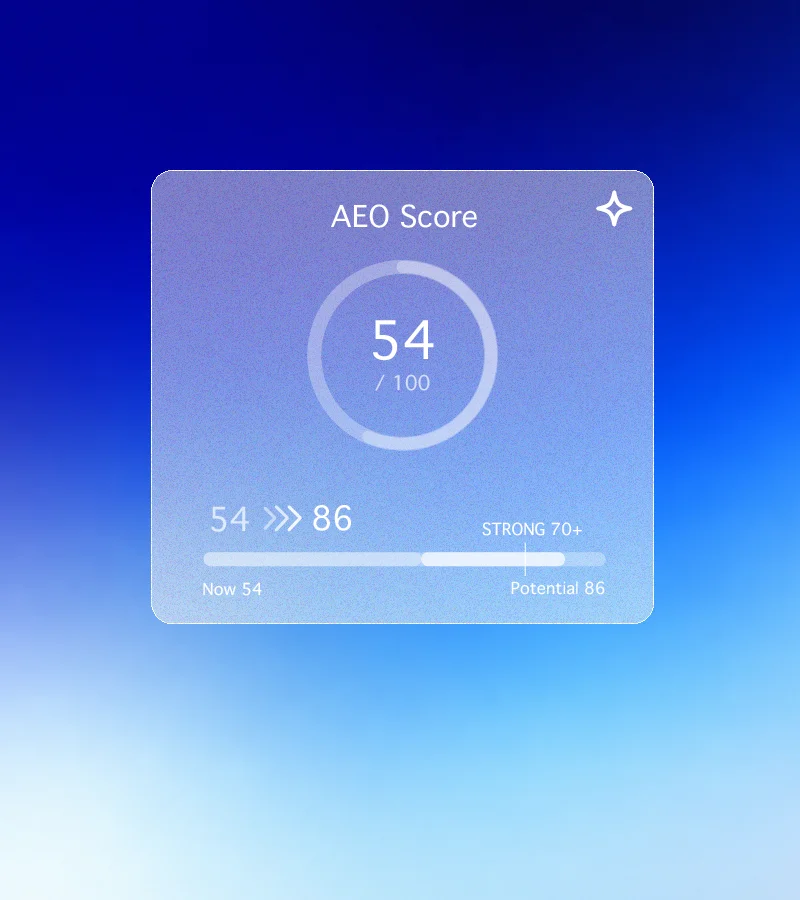
Measure your AI visibility in seconds.
Enter any URL to instantly verify how readable and prepared your content is for AI search, generative engines, LLM citations, and answer engines.
We audit how reads your site and tell you exactly what to fix to start showing up in AI answers.
of all web traffic in 2025 came from bots and automated agents — human activity is now the minority.
Imperva Bad Bot Report, 2026faster year-over-year growth for automated traffic than human traffic in 2025 (23.5% vs 3.1%).
HUMAN Security, 2026monthly users receive synthesized answers via Google AI Overviews, as announced at Google I/O in May 2026.
Google I/O, 2026of Google visits with an AI summary led to a click on a traditional result — versus 15% when no summary appeared.
Pew Research Center, 2025Enter any URL to instantly verify how readable and prepared your content is for AI search, generative engines, LLM citations, and answer engines.
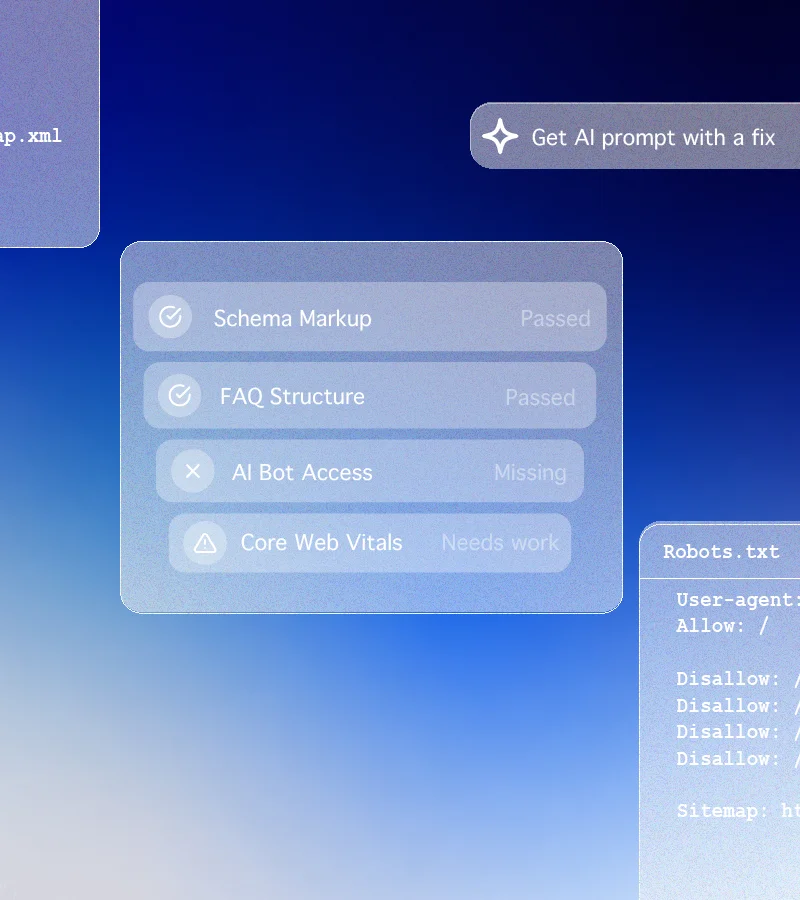
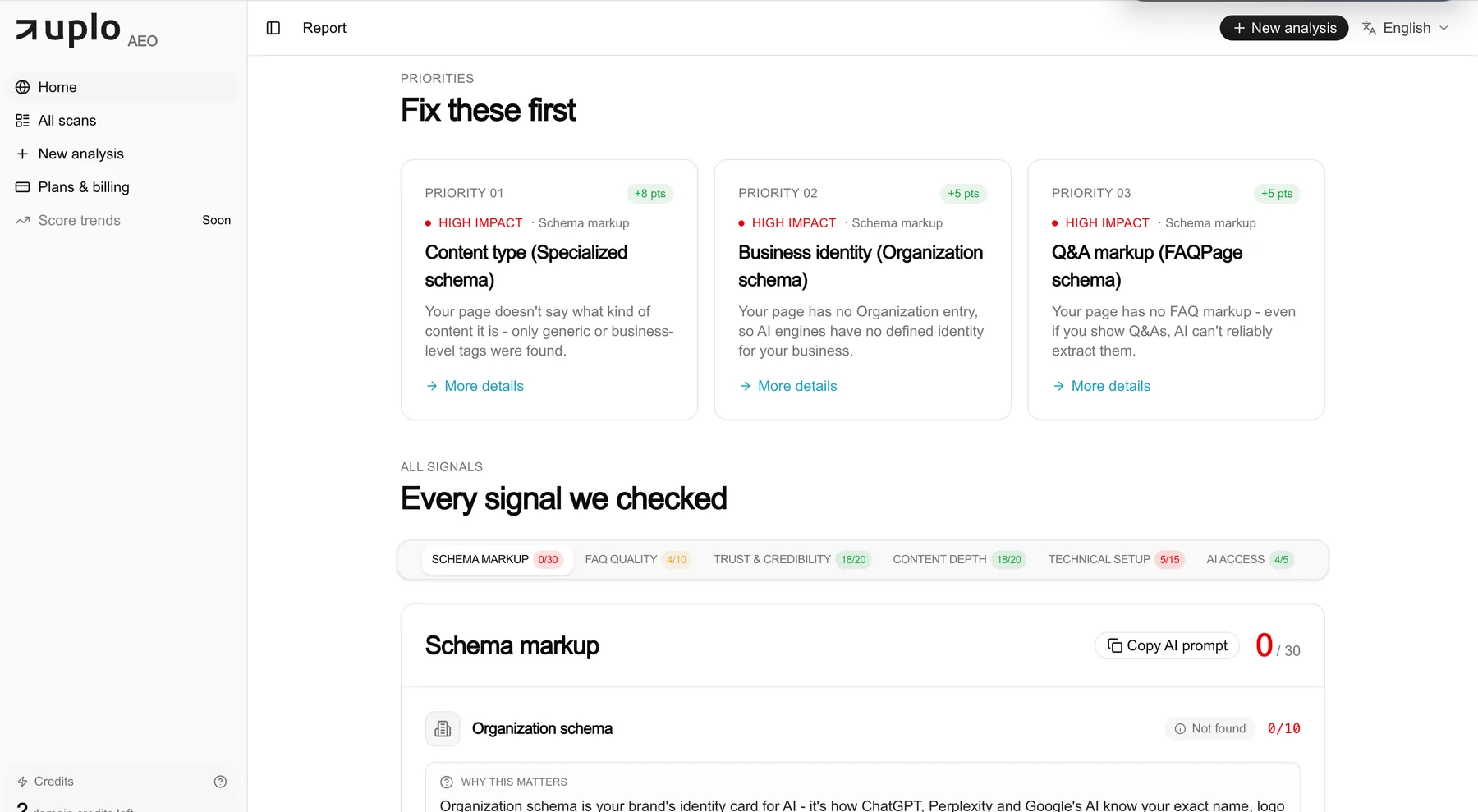
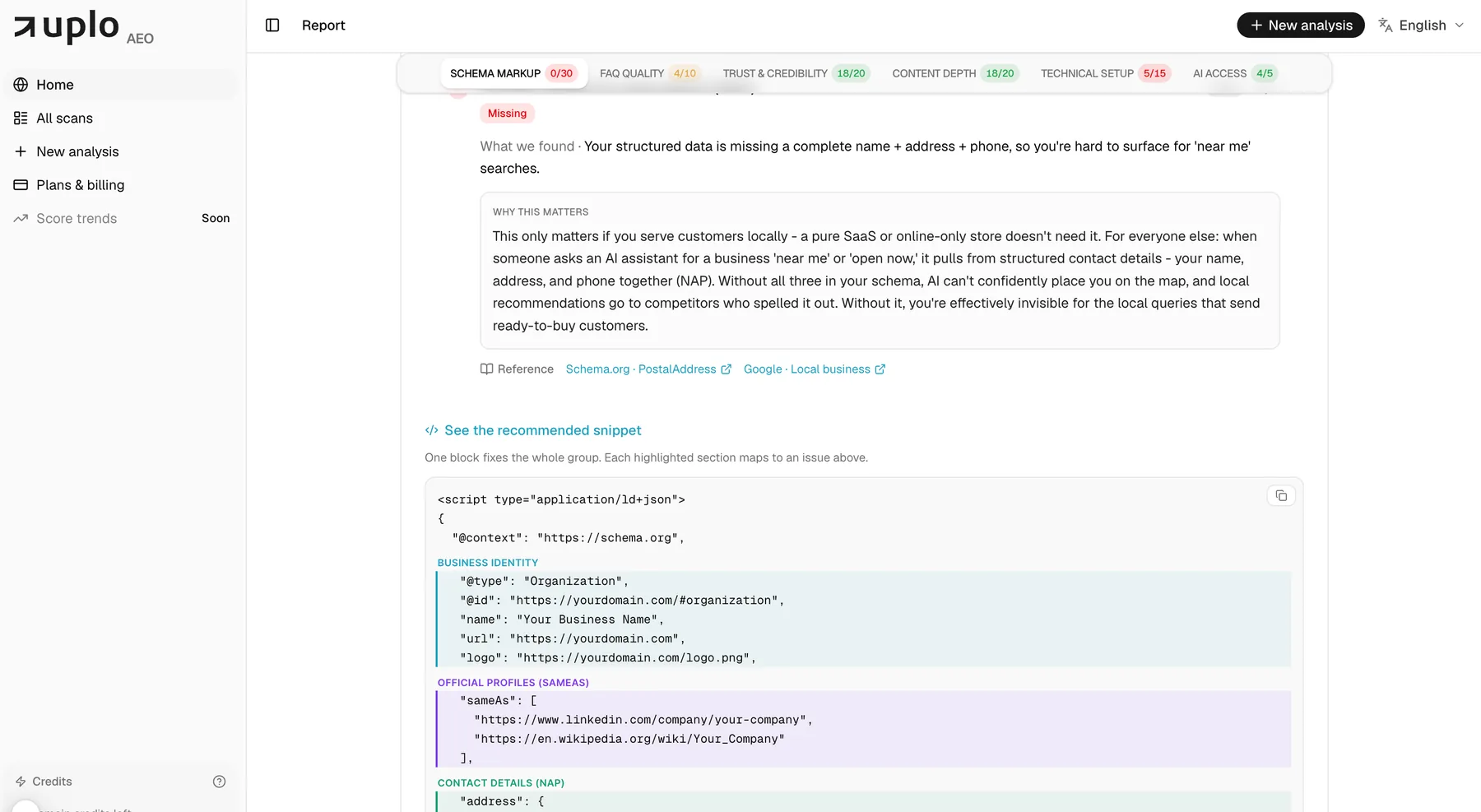
Every important AEO signal - structured data, E-E-A-T signals, FAQ structure, AI crawler access, Core Web Vitals - is evaluated individually against published benchmarks, so you know precisely which fixes to prioritize and which to ignore.
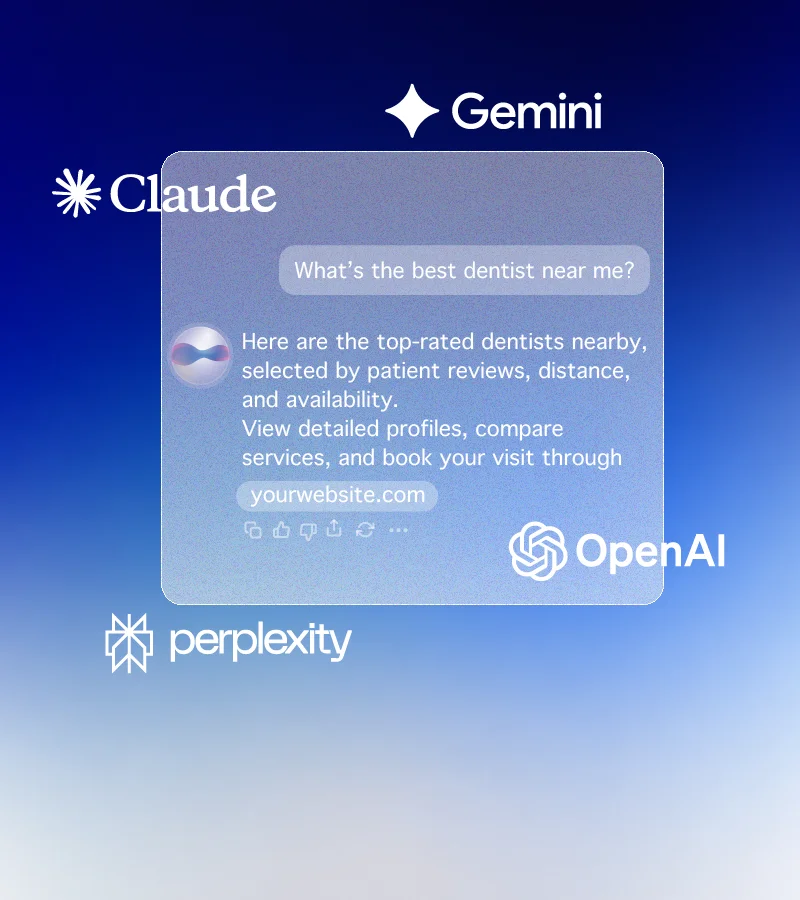
Receive prioritized fixes, implementation examples, and the specific next actions designed to maximize your AI visibility.
AI search hides behind unfamiliar vocabulary. Here's what the score actually measures - in plain language.
A page becomes citable the moment its claims stand on their own - in a blockquote, a definition, or a labeled callout - rather than buried mid-paragraph. That single structural choice, a genuinely quotable and human-readable structure, is what separates pages AI engines cite from pages they merely skim.
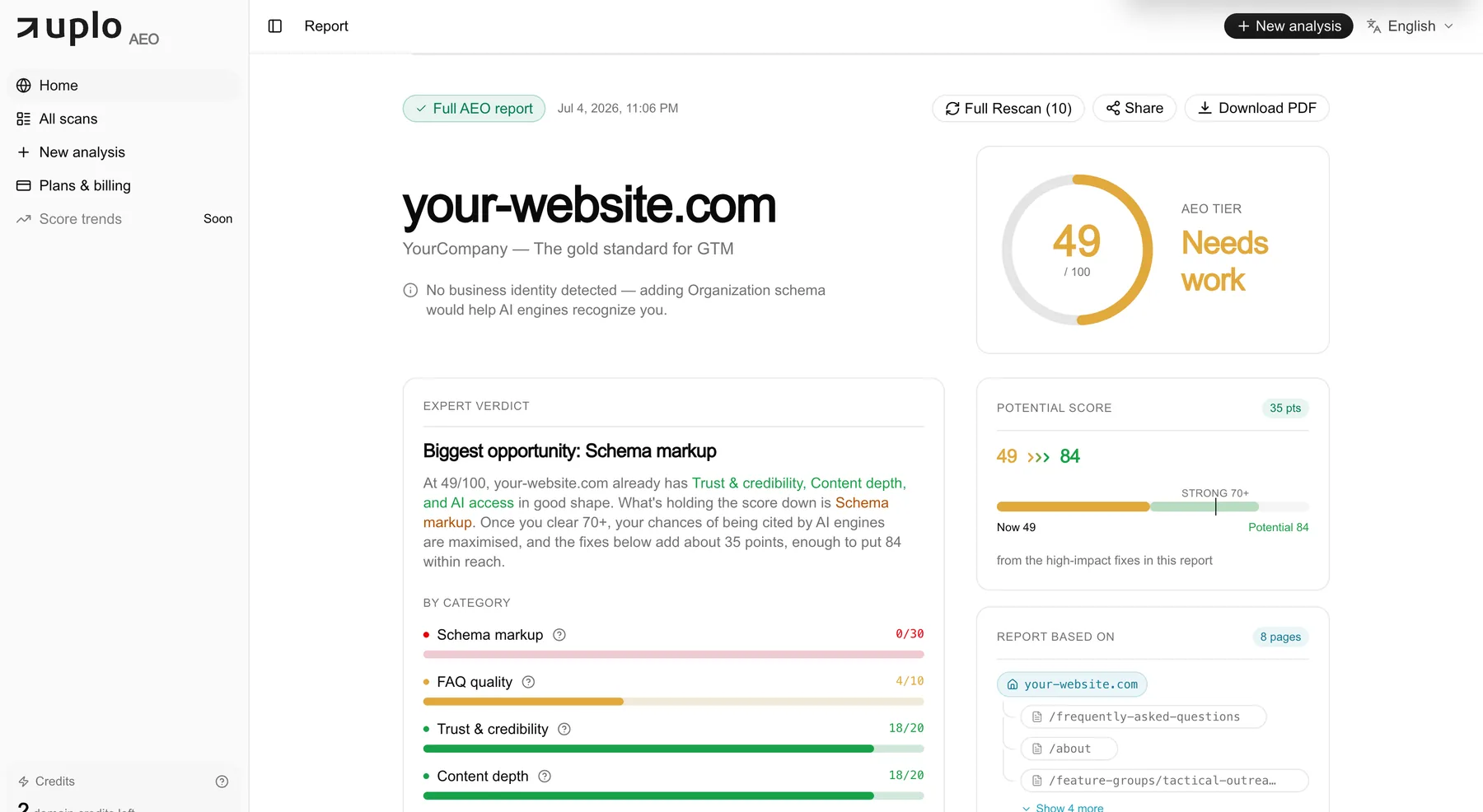
A complete diagnostic in 30 seconds.
Full AEO audits for 2 domains.
Scale across 5 domains with more rescans.
We handle the AEO work, start to finish. More about Uplo
While we're in beta, book a free 30-minute strategy call with the founders — we'll walk through your results and map out what to fix first.
To improve your website's visibility in AI search, make your content easy for AI engines to read, trust, and quote. The highest-impact steps are: add structured data (schema markup) such as Organization, Article, and FAQPage; publish a clear FAQ that answers real questions; strengthen E-E-A-T signals with named authors, citations, and an about page; write thorough content with descriptive headings and concise, quotable answers; and confirm AI crawlers like GPTBot and PerplexityBot aren't blocked in your robots.txt. Uplo scans your page against all of these signals and tells you exactly which to fix first. In our experience, fixing schema markup and FAQ structure first delivers the fastest gains in AI visibility.
Sources:Google · Structured dataGoogle · Helpful content (E-E-A-T)Bing · Webmaster guidelines
AI engines skip pages they can't parse, understand, or trust. The most common reasons a site doesn't appear in AI answers are missing schema markup, no clear author or trust signals, thin or poorly structured content, AI crawlers blocked in robots.txt, and slow-loading pages. Run a free Uplo scan to see which of these are holding your site back.
AEO, or Answer Engine Optimization, is the practice of structuring your website so AI assistants like ChatGPT, Perplexity, and Google AI Overview can find, understand, and cite it. It overlaps with SEO but focuses on machine-readable signals - schema markup, FAQ structure, E-E-A-T, and content depth - rather than keywords and backlinks.
Sources:arXiv · GEO Research Paper
SEO optimizes for ranking in a list of links; AEO optimizes for being chosen as the answer. Traditional SEO emphasizes keywords, backlinks, and rankings, while AEO emphasizes structured data, clear headings, source credibility, expertise, and content an AI can quote confidently. The two overlap, but as search shifts from lists to AI-generated answers, structured and credible content is what gets you cited.
AI engines favor pages that are structured, credible, and quotable. In practice that means valid schema markup, an FAQ or Q&A format, named authors with verifiable expertise and experience, clear structural headings with concise, quotable answers, fast load times, and structured content that isn't blocked from AI crawlers. Uplo benchmarks each of these signals individually and scores your page from 0 to 100.
Sources:Google · Structured dataGoogle · Helpful content (E-E-A-T)
Uplo is an AEO (Answer Engine Optimization) analyzer. It audits how well your website is set up to be found and cited by AI search engines like ChatGPT, Perplexity, and Google AI Overview, then gives you an AEO score and a prioritized list of fixes - in under 30 seconds.
Uplo scores your site against the signals that drive visibility in ChatGPT search, Perplexity, and Google's AI Overview - schema markup, FAQ quality, author and trust signals, content depth, and technical fundamentals like load speed and mobile-friendliness.
Under 30 seconds. Uplo fetches your page, runs it through Google PageSpeed and Rich Results, extracts every AEO signal, and flags the most damaging issues - all in parallel.
The paid report includes everything in the free audit plus the full breakdown of every signal Uplo checks, with per-metric advice, impact levels, prioritized fixes, ready-to-paste structured-data snippets, and AI-ready prompts to fix each issue. It's delivered instantly, individually prioritized, and by email.